

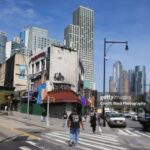
News Americas, NEW YORK, NY, Tues. Dec. 9, 2025: There are certain words you avoid as a writer because they carry emotional landmines. You avoid them because they evoke old wounds, introduce political tension, or reveal uncomfortable truths that society is still not ready to confront. Gentrification has always been one of those words for me. I remained silent on it for years. I stayed away from debates that felt too charged or too politicized. I convinced myself that objectivity required restraint. Yet, there comes a moment in a writer’s life when silence becomes a betrayal of lived experience. Today is that moment. There it is, I finally said it. The G-word.

I grew up in inner-city America. Before that I grew up in Kingston, Jamaica where race was not the lens through which people experienced the world. My understanding of privilege and oppression was shaped by class structures and colonial residue, not by skin color. When I moved to the United States at the age of thirteen, the first place I lived at was the South Bronx. Simpson Street, Intervale Avenue, then Gun Hill Road, etc. These were not the glamorous symbols of the American dream. They were gritty and alive, tough yet communal, and they carried a pulse that outsiders rarely understood. If you were not from those neighborhoods, you stayed away. But for those who lived there, these places were home. They were the first chapters of my American story.
I remember my early visits to Harlem in 1999, long before its renaissance was mainstream, when 125th Street exploded with music, laughter, street art, food, and the distinct feeling of belonging. You could walk down Adam Clayton Powell Boulevard and feel the rhythm of a people who had created beauty from struggle. Harlem was a cultural mecca, a world within a world, a place that reflected the fullness of Black identity. To someone coming from Jamaica where racial tension was not embedded into everyday life, Harlem was powerful. It was bold. It was love wrapped inside resistance.
Over the last twenty years, however, the Harlem I knew has changed. So has the South Bronx. So has Brooklyn. So have dozens of communities across the United States. And the leading force behind that transformation is the very word I avoided: gentrification.
When I started my graduate program in Public Health, I had a professor who altered the course of my worldview. Dr. Green, a white American woman with a fierce understanding of socioeconomic inequality, assigned a simple task. She asked us to write about whether gentrification was good or bad for minority communities. At the time, my argument was that it was good. I came from neighborhoods lacking resources. We did not have access to fresh groceries, quality schools, healthcare facilities, or safe recreational spaces. Businesses did not dare enter certain blocks of the South Bronx or East Harlem. When gentrification brought stores, transportation upgrades, and new buildings, it felt like an upgrade. It felt like the kind of revitalization every forgotten community deserved.
I wrote my paper with conviction. I believed my stance was morally sound. I believed improvement meant progress. And I will never forget the look Dr. Green gave me after reading it. It was not disgust. It was disappointment. She challenged the inadequacy of my position because I had missed the heart of the matter. I had overlooked the most critical element of gentrification: its human cost.
What she explained to me became the foundation of my evolving understanding. She showed me that gentrification is not merely about economic uplift. It is about the destruction of culture. It is about the erasure of history. It is about the displacement of families who have already survived decades of hardship, only to be forced out once the value of their neighborhoods becomes recognized. She taught me that revitalization without protection is not improvement. It is invasion. It is the theft of memory masked as progress.
Years later, as a more seasoned scholar and professional, I walked the streets of Harlem again. It was 2015, and I saw a very different landscape. On the West Side, near Frederick Douglass Boulevard, I saw Whole Foods, designer shops, trendy restaurants, and buildings with rent prices that rivaled Midtown. They were marketed as the new Harlem, the reimagined Harlem, the “finally improving” Harlem. But when you crossed east of Fifth Avenue, reality shifted. Suddenly it felt like a different world. It looked like the aftermath of a society that had given up on its people. It looked like abandonment.
East Harlem had become a shoebox in many ways, overcrowded and starved of opportunity. It was still plagued by drug use and homelessness, yet ironically, many of the homeless individuals you saw on the East Side were formerly housed West Side residents who were priced out of their homes. They were pushed across avenues and told to make do. They were casualties of an economic model that rewarded newcomers and punished the original custodians of the community.
It is here that the moral and societal implications of gentrification become unavoidable. If a new community can only flourish when the old one suffers, is that truly progress? And why has gentrification become such a zero-sum game? Why does someone have to lose their home for someone else to gain convenience? Why does someone’s cultural identity have to be erased for fancy coffee shops to appear?
This is not an argument for equal distribution of wealth. This is not an argument for everyone receiving the same opportunities in a capitalist society. The point is far deeper. It is about acknowledging that urban development without equity is simply modern displacement. It is repackaged inequality. It is the same injustice with a cleaner tone and a more polite vocabulary.
There was a film I watched when I was younger, starring Laurence Fishburne, Cuba Gooding Jr., and Ice Cube. Fishburne played a professor who warned the younger characters about gentrification. At the time, none of us truly grasped what he meant. It sounded theoretical and distant, a concept belonging to policy analysts, not the average kid on the block. As children, we saw it as an academic idea, not a lived threat.
Years later, many of the kids who watched that movie saw their own families pushed out of their homes. Many saw their parents lose their property, not because they were financially irresponsible, but because the rules of the game shifted. New developers, new buyers, new price points, new language, new loopholes. And suddenly the people who had held their communities together through the drug epidemic of the 70s, the violence of the 80s, and the crippling hardships of the 90s were being told they did not belong in the very places they helped sustain.
Communities that survived poverty, racism, underfunded schools, disinvestment, police aggression, and systematic neglect were defeated not by drugs or violence, but by rising rent. They were defeated by an economic apparatus they never agreed to. They were defeated by valuation models that had nothing to do with their lived reality.
What happens to a community’s spirit when the last blow comes not from hostility but from “progress”? What happens when survival is no longer enough to stay?
A friend once asked me whether the people who lived through these eras could ever truly heal. It is a profound question. Healing is possible when harm is temporary, when the wound is localized, and when the environment eventually becomes safe again. But how do you heal from something that takes not your possessions but your place? How do you heal from losing your community, your roots, your cultural ecosystem, your memories? What do you do when survival is followed by displacement rather than relief?
People have survived the 70s slums, the 80s crack era, the 90s policing crisis, mass incarceration, unemployment, and urban decay. Many of those same people now face the emotional devastation of losing their homes to rising rent, legal manipulation, or private development. They survived decades of external threats only to lose their neighborhoods to a process disguised as improvement.
Healing requires acknowledgment. Healing requires truth. Healing requires inclusion. Yet in gentrified landscapes, the narrative rarely centers the displaced.
It centers property value.
It centers new businesses.
It centers rising tax revenue.
It centers the “new community.”
So where does the healing begin? And more importantly, who leads it?
Gentrification is often framed as an economic phenomenon, but beneath the economics lies a moral crisis. It raises questions about justice, equity, and dignity. It forces us to confront who deserves stability and who is treated as replaceable. It exposes the cracks within urban planning, public policy, and political priorities.
At its core, gentrification represents a failure of policy and imagination. It exposes our inability to revitalize neighborhoods without sacrificing the people who built them. It shows how far we are willing to go to pursue growth, even when growth becomes synonymous with erasure.
We must ask whether revitalization is truly revitalization when it excludes the original residents from enjoying the benefits. We must ask whether it is progress when affordability becomes a relic of the past. And we must question why displacement has become an acceptable byproduct of development.
If we are willing to confront the truth, then we can also imagine a future that does not rely on displacement. A post-gentrification vision is possible. It requires leaders, policy makers, developers, and communities to rethink the fundamental principles of urban development.
A better model would include:
1. Affordable housing guarantees for original residents.
Long-term affordability must be protected through legal structures, not political promises.
2. Community land trusts and resident ownership.
When the community owns the land, displacement becomes optional, not inevitable.
3. Cultural preservation zones.
Protect the identity of neighborhoods in the same way historic districts are protected.
4. Equitable development frameworks.
Prioritize local hiring, local businesses, and generational wealth for long-time residents.
5. Mixed-income models that center dignity.
Housing should not segregate communities based on economic worthiness.
6. Public health analysis in development decisions.
Look at the psychological and social effects of displacement, not just economics.
7. Policy reform that places humanity at the center.
Cities should not become playgrounds for the wealthy at the expense of the poor.
Healing begins when people are no longer treated as collateral damage. Healing begins when development becomes inclusive rather than extractive. Healing begins when we stop believing displacement is the price of progress.
For years, I avoided speaking about gentrification. I thought neutrality was safer. Yet neutrality in the face of cultural loss is a quiet form of surrender. Gentrification is not simply a policy issue. It is not merely an economic trend. It is a human story, one filled with memory, identity, displacement, and unspoken grief.
Communities are not just geographical spaces. They are living archives of struggle and triumph. When they are erased, something irreplaceable disappears.
So here I am, no longer silent, finally naming it. Gentrification. The G-word that reshaped the communities I knew, the neighborhoods that raised me, and the places that shaped who I am today. We must explore it, question it, and challenge it, not with rage but with understanding. Not with despair but with vision. Not with resignation but with hope that the future does not have to mirror the past.
This is the real work of writers, leaders, and thinkers. To see what is broken, to understand why it matters, and to imagine what can be rebuilt.
British Caribbean News